I came across Stafford Beer’s Viable System Model (VSM) in 2005 when I was studying it as part of an undergraduate degree. As soon as I started using it, I knew that applying it in the real world meant that I had to consider much more than just the model itself. I immediately focused on the more human side of the situation, with an emphasis on the interaction between human, situation and approach. I wrote about Creating the Conditions for Change in my own life situation back in 2005, which was the first time I had fully acknowledged my own thinking and how Beer’s work made sense to me. I went on to experiment with the VSM, predominantly in public services (especially NHS commissioning) and have worked with it in a variety of environments since then, including a number of years working on place based systems change. My approach, which is laid out below was established during my early work and has developed since 2005 (and is still developing).
My question: my question has always been, ‘how can the viable system model (and its associated concepts and ideas) be successfully applied in real world situations, particularly by those who have not undergone academic qualifications in systems thinking’.
My hypothesis: after years of using the VSM, I hypothesize that, for successful application we need to consider three things:
1. Development of the perceptual receptivity of the individual
2. The conditions in which application is happening (and that includes things like the relationships and social networks and how we learn. In my work I use VSM and CAS as complementary frameworks)
3. How we operationalize the VSM (using VSM in its more traditional way, as complementary to the above)
Central to this hypothesis: I believe that central to successful application is the perceptual receptivity of the individual. The conditions and operationalization surround this.
My work to date: My work to date has gone beyond just understanding the VSM as a stand-alone model. I capture my work in the Creating the Conditions for Change© branded approach, where I start to lay out the interplay between all three elements, placing development of the individual as central and make visible the conditions that can shift the underlying paradigm to one of learning and orientation. What is not shown in these materials is the operationalization on the VSM in its more technical form, which I hold in separate documentation. Below is V7 of the ‘Systems Thinking Change Wheel’, the infographic for Creating the Conditions for Change© which I updated again in 2026. The work was named ‘relationship mode VSM’ in my training courses between 2016 to 2019. Creating the Conditions for Change© was a dominant part of my training back then and I have continued to refine the infographic since, although it remains predominantly the same.
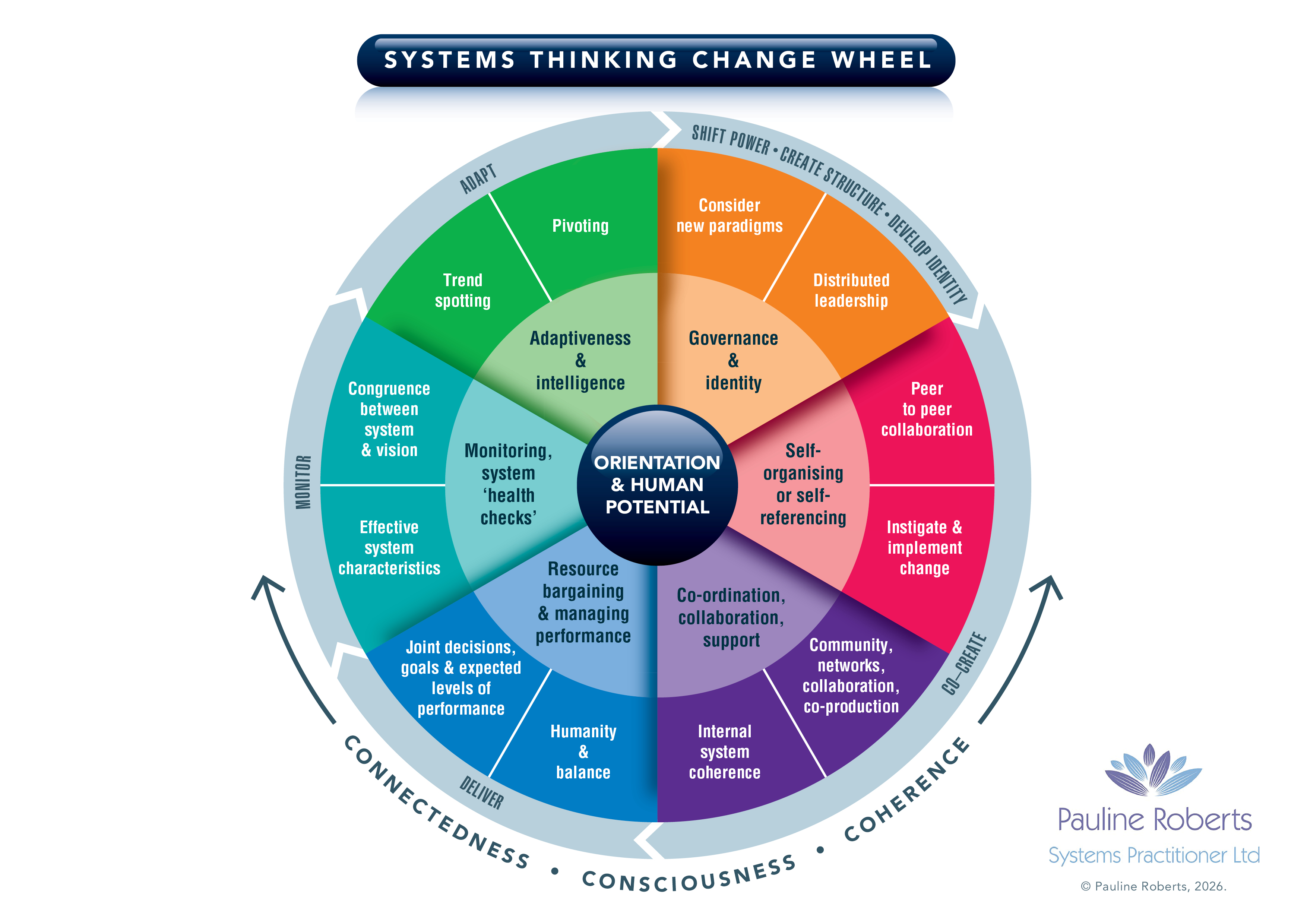
My desire: a number of years ago I wanted to take this work into a PhD. I have since learnt a lot about the world of academia and now choose to continue the development of the work on my own terms and capture it in books instead. I am currently writing my second book. My first book ‘Crossing the Bridge’ laid out the formative years of my practice towards the development of Creating the Conditions for Change©. My next book will take this even further and consider the questions and hypothesis I lay out to a greater degree.

 systems practitioner Ltd